Archducal throne
The KillerThe Archducal throne makes sovereignty visible as a position that can be occupied, seized, and handed on. Duncan sits on it for the healing rite; Macbett later points to it as evidence that he has taken power; after Macbett is killed, Macol orders a throne brought for him. Across these scenes, the object gives political succession a concrete stage image, while the changing acts of homage around it reveal the force—and fragility—of royal authority.
Duncan’s throne and the healing rite
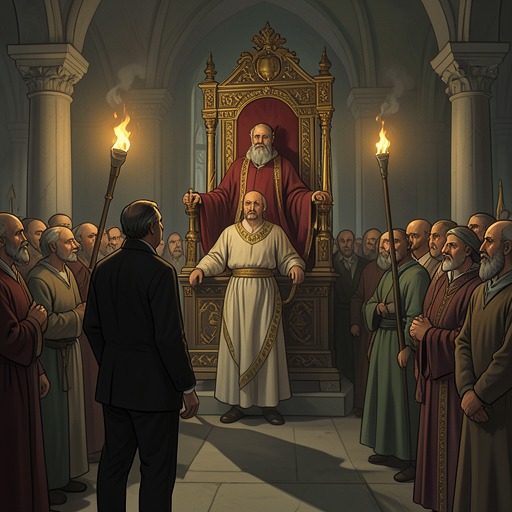
At the healing scene, Duncan rises and mounts the throne, then sits. The officer stands on his left, while the monk, after blessing the scepter Duncan is to use to touch the sick, moves to his right. Duncan then orders the patients brought in. The prescribed positions lend the scene a formal symmetry: the monarch occupies the center of authority, flanked by the officer and the religious attendant, as the ritual is prepared to begin.
The throne is not merely background to the ceremony. Duncan’s elevated seat and the blessing of the scepter present royal power as an instrument intended for the care of the sick. The stage direction calls for solemnity, making the arrangement itself part of the rite’s meaning. The throne therefore links political status to a public performance of sacred and healing authority; its significance comes not only from who sits in it, but from the actions the seat authorizes and the ritual that surrounds it.
Macbett’s claim and Duncan’s return
Later, during the guests’ feast, Banco disappears and Duncan appears, mounting the throne. The guests recognize the figure as the Archduke, and Duncan faces the audience from the seat while Macbett and the guests have their backs to it. The staging restores Duncan to the position associated with sovereign rule even as Macbett remains the living ruler in the room. The throne becomes the focal point of a confrontation between present possession and the authority Macbett has displaced.
Macbett challenges the guests’ readiness to believe in Duncan after dismissing Banco as unreal. He suggests that their accustomed homage to their former sovereign accounts for their awe, then tells Duncan that he has taken both the throne and Duncan’s wife. He reminds Duncan that he served him and was distrusted, before drawing his dagger and ordering the guests to recognize no king but himself. Their terrified retreat makes the throne’s political meaning unmistakable: physical occupation alone does not secure allegiance, so Macbett must turn possession into a demand for public submission.
The throne after Macbett
After Macbett’s death, Macol orders his body taken away and calls for a throne. Two guests carry off the body while the throne is brought on, so the removal of the defeated ruler and the arrival of the new seat of power occur at the same time. A guest invites Macol to sit. The other guests then arrive, and some raise placards declaring that Macol is always right; their acclamations hail both the new sovereign and Banco’s dynasty.
Bells sound as Macol stands by the throne and the bishop enters. Macol asks whether the bishop has come to crown him, and the bishop confirms it. The scene presents accession as a sequence of visible acts: the old ruler’s body is removed, the throne is installed, public praise begins, and a coronation is prepared. Yet the repeated transfer of the seat does not suggest that power itself has been transformed. Macbett’s coercive demand for homage gives way to Macol’s acclaim and the promise of another reign, while the throne remains the same emblem around which obedience is organized.
Dramatic significance
The throne’s recurring appearances compress political change into stage business that an audience can see: Duncan mounts it, Macbett asserts that he has taken it, and Macol requests one after Macbett is dead. In each instance, the seat gathers attendants and spectators into a hierarchy, arranging bodies around a sovereign center. The shifts in who commands that center matter, but the ceremony of recognition matters too: the officer, monk, guests, and bishop each help frame or ratify authority through their positions, actions, or words.
The object thus carries a pointed contrast between continuity of office and instability of rulers. Duncan’s healing rite associates the throne with solemn, sanctioned service; Macbett’s dagger-backed orders expose rule as force imposed on frightened witnesses; Macol’s accession surrounds the throne with acclamation and an approaching coronation. The sequence changes the occupant while preserving the apparatus of sovereignty. The Archducal throne is both a seat and a stage-made argument about power: rulers may fall, but the practices that elevate a new ruler can begin again around the same symbol.